A golfer’s honest take on playing Cambodia’s courses, what you’ll actually spend, and why combining golf with Angkor Wat makes perfect sense
I’ll be straight with you: when friends suggested adding Cambodia to our Southeast Asia golf trip, I was skeptical. Thailand and Vietnam get all the attention, and for good reason they’ve got the established courses, the infrastructure, the reputation. But Cambodia? That felt like a gamble.
Turns out, it was one of the best golf decisions I’ve made. Not just because the golf exceeded expectations, but because nowhere else can you play a Jack Nicklaus II-designed championship course in the morning and explore Angkor Wat temples in the afternoon. And do it all without breaking the bank.
Here’s everything I learned about golf costs in Cambodia, what you’ll actually pay (including those often-confusing caddie tips), and why this emerging destination deserves serious consideration for your next golf trip.
| No. | Name | No. of Holes |
| 1 | Siem Reap Booyoung Country Club | 18 |
| 2 | Phokeethra Country Club | 18 |
| 3 | Grand Phnom Penh Golf Club | 18 |
| 4 | Garden City Golf Club | 18 |
| 5 | Cambodia Golf & Country Club | 18 |
| 6 | Angkor Golf Resort | 18 |
| 7 | Vattanac Golf Resort | 36 |
| 8 | Royal Phnom Penh Golf Club | 18 |
| 9 | Chhun On Golf Resort | 18 |
📧 Email: creative@asiagolfjourney.com
📞 Phone: +84 982 117 466
🌐 Website: www.asiagolfjourney.com
Let’s cut through the marketing fluff and talk actual money. Most Cambodia golf courses bundle everything into simple packages that make budgeting straightforward. When I played Vattanac Golf Resort outside Phnom Penh the course that hosted the Legends Tour last year the pricing worked like this:
Sharing buggy package: $110 USD total. That’s your green fee, one caddie shared between two golfers, and one golf cart shared between two players. If you’re traveling with a buddy or get paired up, this is your baseline cost.
Single buggy package: $120 USD total. Same deal but you get your own cart. The extra ten bucks buys you cart privacy, which honestly felt worth it when I wanted to decompress between holes without making small talk.
These aren’t promotional rates or “starting from” prices that mysteriously inflate when you actually book. This is genuinely what you’ll pay at quality courses across Cambodia. Weekday rates sometimes drop 10-20%, and there’s seasonal variation, but $110-120 covers the vast majority of situations.
Compare that to Thailand where decent courses start at $150 and premium ones hit $200+, or Vietnam’s top courses pushing $130-180. Cambodia delivers legitimate championship golf at prices that make playing multiple rounds actually affordable.
Here’s where things get interesting and slightly confusing if you’re used to Western golf or even Thailand’s more established tipping norms. Cambodia caddies work on a shared system one caddie serves two golfers. Your $110 package includes the caddie fee (what the course pays them), but you’re expected to tip on top of that.
The real range is $15-40 USD per golfer, which I know sounds wide, but it reflects genuine service quality differences I experienced across multiple rounds.
At Garden City Golf Club, my caddie was competent but quiet did the job, gave decent yardages, didn’t offer much strategic input. I tipped $20, felt appropriate for solid if unspectacular service. My playing partner did the same, so the caddie got $40 total.
At Vattanac, though? Different story entirely. My caddie had incredible green-reading ability, talked me out of two genuinely stupid club choices, and somehow knew exactly when I needed encouragement versus when to just let me stew after a bad shot. That’s the kind of round where $35-40 feels right because she legitimately saved me five strokes.
I’ve also seen golfers tip $15 when service was genuinely poor distracted, slow pace, minimal effort. And I’ve heard stories of exceptional days warranting $50+, though I didn’t personally experience that.
The practical takeaway: Budget $25 per round for caddie tips. That’s middle-of-the-range, appropriate for good service, and leaves room to go higher for excellence or slightly lower if things disappoint. Since you’re sharing the caddie, coordinate with your playing partner so the caddie gets fair total compensation if you both tip $25, that’s $50 to the caddie, which is solid.
One critical note: bring US dollars in cash. Cambodia operates on a dollar economy, and caddies strongly prefer USD. I carried $5, $10, and $20 bills which worked perfectly. The clubhouse ATMs dispense dollars if you run short.
Cambodia has exactly 10 operational 18-hole courses across 9 brands. That’s tiny compared to Thailand’s 250+ courses or Vietnam’s 100, but it’s actually refreshing you’re not overwhelmed with choice paralysis, and you can genuinely research each course’s character.
The game-changer has been international golf management arriving in Cambodia. IMG and Troon Golf are now involved in course operations, which shows in tangible ways. When Vattanac hosted the Legends Tour in 2024, that wasn’t some fluke it reflected genuine championship-standard conditions and operational capability that wouldn’t have existed five years ago.
My Cambodia rounds included:
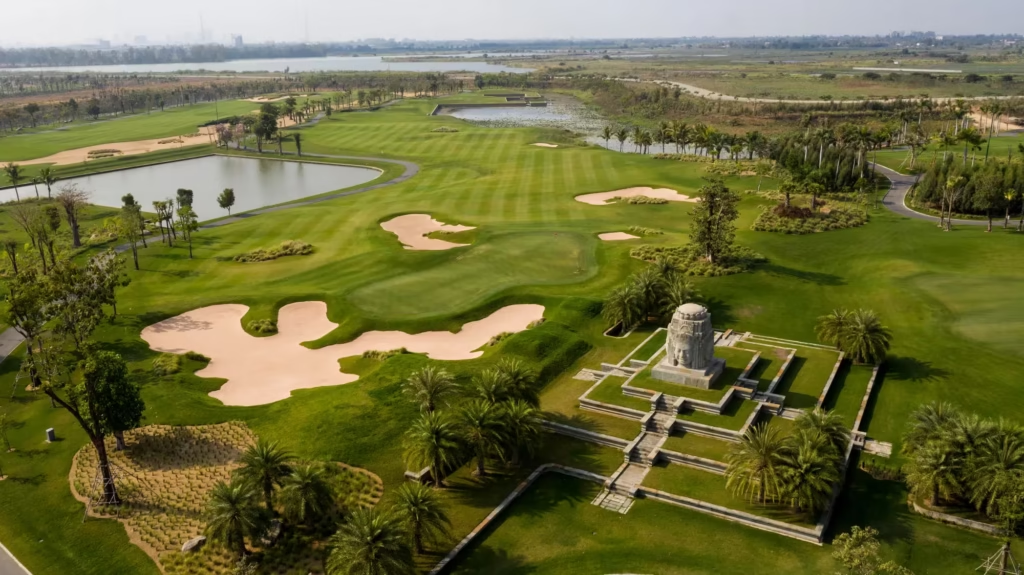
Vattanac Golf Resort outside Phnom Penh was the highlight Jack Nicklaus II design with strategic bunkering, risk-reward holes, and conditioning that rivaled anything I’ve played in Thailand. The Legends Tour hosted here wasn’t charity; this course earned it through quality.
Phokeethra Country Club near Siem Reap offered the only Nick Faldo-designed course in Cambodia. More resort-style than Vattanac but still engaging golf, with the massive bonus of being 15 minutes from Angkor Wat. Playing morning golf then exploring temples in afternoon heat made logistical sense.
Garden City Golf Club felt more local, which I appreciated less polished than the international-standard courses but authentic, with significant Korean membership presence (you’ll hear a lot of Korean on the course and see Korean signage).
The other courses I didn’t play, but conversations with local golfers suggested generally good quality across the 10, with some more basic but none genuinely poor.
The affordability got me to Cambodia, but other factors made me glad I came and genuinely planning to return.
My Actual Three-Day Trip Budget Breakdown
Let me show you exactly what I spent across a three-day Cambodia golf trip:
Golf (3 rounds): $330 (Vattanac $120 single buggy, Phokeethra $110 sharing, Garden City $100 weekday rate)
Caddie tips (3 rounds): $70 ($25, $35, $10 the Garden City caddie earned the low tip, unfortunately)
Hotel (3 nights, mid-range Siem Reap): $180 ($60/night including breakfast)
Angkor Wat temple passes and guide: $140 (multi-day pass plus private guide)
Transportation (airport transfers, course shuttles, temple transport): $75
Meals and drinks (non-golf): $140 (Cambodia food is incredibly affordable)
Random expenses (souvenirs, tips, extras): $50
Total: $985 for three days including three rounds of championship golf, comprehensive Angkor Wat exploration, comfortable accommodation, all transportation, and meals. That’s exceptional value for what I got.
For comparison, a similar three-day trip in Thailand three rounds at decent courses, mid-range hotel, some cultural activities would easily run $1,400-1,600. Vietnam would split the difference at $1,200-1,400.
Bring enough US dollars. I withdrew $400 before arriving and used almost all of it. Credit cards work at hotels and nicer restaurants, but golf courses, caddies, local transport, and street vendors are cash economies.
November through March is objectively the best time to play. I visited in February and had perfect conditions dry, mid-80s temperature, no rain. May through September is wet season; courses are still playable, but afternoon downpours are common and humidity is brutal.
The cultural tourism isn’t optional; it’s the whole point. Golf-only Cambodia trips miss what makes this destination unique. Build in afternoon temple visits, evening traditional dance performances, local market exploration. The golf is great; the complete experience is spectacular.
Communicate with your caddie early about what you want. My Vattanac caddie asked within three holes if I wanted lots of green reading help or preferred minimal input. That self-awareness made the whole round better. If your caddie doesn’t ask, tell them your preference.
Don’t expect Thailand-level English proficiency everywhere. Premium courses like Vattanac and Phokeethra have solid English-speaking staff. More local courses, you’ll navigate with simpler English, hand gestures, and smiles. It’s manageable and honestly part of the charm.
Getting Help Planning Cambodia Golf
If you’re reading this and thinking “this sounds great but I have no idea how to actually book Cambodia golf courses,” I get it the country’s tourism infrastructure is improving but not yet seamless.
Asia Golf Journey specializes in exactly this kind of trip they handle tee times at Cambodia’s courses, arrange transport, suggest hotels near courses, and for those of us who want the golf-plus-culture approach, they coordinate temple tours and guides. They work across Southeast Asia, so if you’re doing that multi-country circuit I mentioned (Thailand-Cambodia-Vietnam), they handle the whole thing.
For golf courses reading this: AGJ also does international marketing and branding for courses trying to break out of the Korea/China market dependence. If you’re a Cambodia course operator wanting to attract more Western golfers, they’re worth talking to.
📧 Email: creative@asiagolfjourney.com
📞 Phone: +84 982 117 466
🌐 Website: www.asiagolfjourney.com