Inbound golf tourism has emerged as one of the most lucrative segments of global luxury travel. High-Net-Worth Individuals (HNWIs) traveling internationally for golf do not just book green fees, they spend heavily on five-star accommodations, premium dining, private transport, and high-end Pro Shop merchandise. However, capturing this affluent global audience requires a digital presence that breaks down linguistic and geographic barriers.
Relying on a monolingual, locally optimized website means your course remains invisible to elite golf travelers in key feeder markets like South Korea, Japan, Europe, or North America. Here are the strategic recommendations for dominating inbound golf tourism marketing through high-converting digital platforms.
True digital hospitality begins with how you greet an international user. Many golf course operators make the mistake of using generic Google Translate widgets, which often butcher specialized golf terminology (e.g., translating “birdie”, “fairway”, or “tee time” into literal, confusing local words).
A premium multi-language golf website design rejects automated shortcuts in favor of professional, native-vetted localization. This means tailoring the content layout to the specific cultural nuances of your target markets. For instance, a Korean golfer looks for detailed information about caddie culture and post-round sauna facilities, while a Western golfer prioritizes walking-course regulations. Speaking their language accurately through targeted design signals elite service standards and builds immediate trust before they even step onto the property.
Compatition between native localization vs. Automated translation
A masterclass in global digital strategy within Southeast Asia is demonstrated by Hoiana Shores Golf Club (Vietnam). At first glance, Hoiana maintains a rigid, highly cohesive visual layout across all linguistic profiles to safeguard its luxury brand identity. However, a deeper inspection of its multi-language golf website design reveals that the platform does not merely translate text 1-1; it dynamically swaps the underlying commercial products to match the distinct travel behaviors of domestic versus international affluent segments.
This sophisticated content logic is clearly manifested in their “Related Offers” interface structure. On the Korean-language platform, the system targets high-spending inbound golf tourists who execute long-haul travel. Consequently, the visual grid entirely bypasses casual packages to promote high-ticket items: multi-week luxury residence rentals, advanced “Early Bird” packages bundled directly with championship green fees and airport shuttles, and long-stay extension discounts.
Conversely, when a user switches to the Vietnamese interface, the exact same three-card layout is dynamically populated with domestic-centric products. It pivots to feature room-only flexibility (“Essential Stay”), short-term family leisure activities, and premium day-cation passes for local residents (such as pickleball or water-park access). By keeping the architectural design standardized while executing radical, culturally tailored product swaps in the backend, Hoiana sets a phenomenal benchmark for high-conversion international golf marketing.
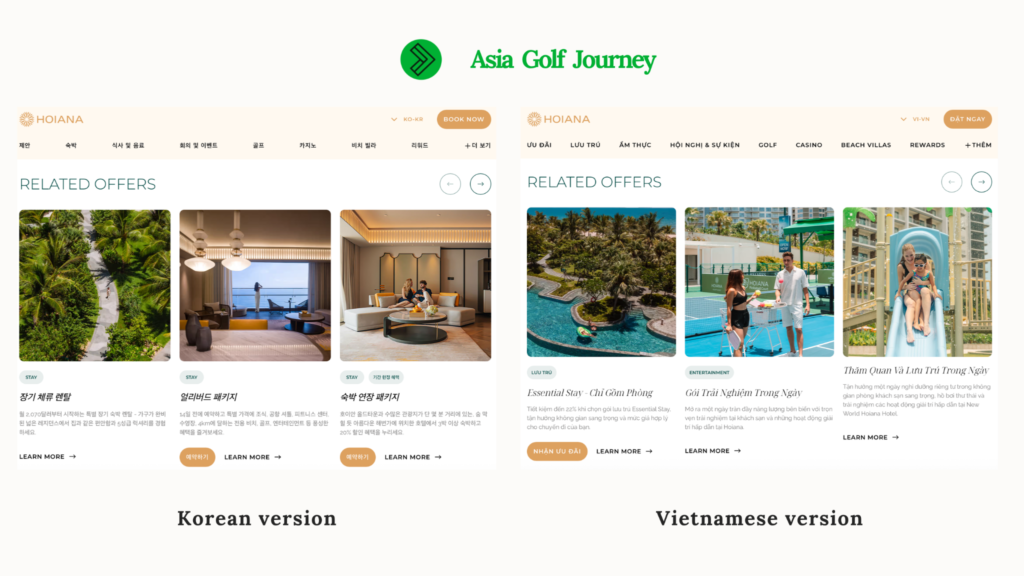
Comparison between Korean version & Vietnamese version of Hoiana Shores Golf Club website
The ultimate test of a successful multi-language golf website design is its checkout flow. High-net-worth travelers expect a seamless, secure transaction process that accommodates international financial habits.
Your booking engine must dynamically adapt its user interface based on the selected language profile. A robust multi-language design displays real-time currency conversion rates (e.g., KRW, JPY, USD, EUR) and integrates global payment gateways like Visa, Mastercard, Amex, alongside region-specific options like UnionPay or JCB. Additionally, ensure that automated reservation confirmations, dress code guidelines, and handicap verification requirements are sent in the guest’s native language via SMS or email. Eliminating these friction points within the website architecture is the fastest way to minimize abandoned bookings and secure high-value international reservations.
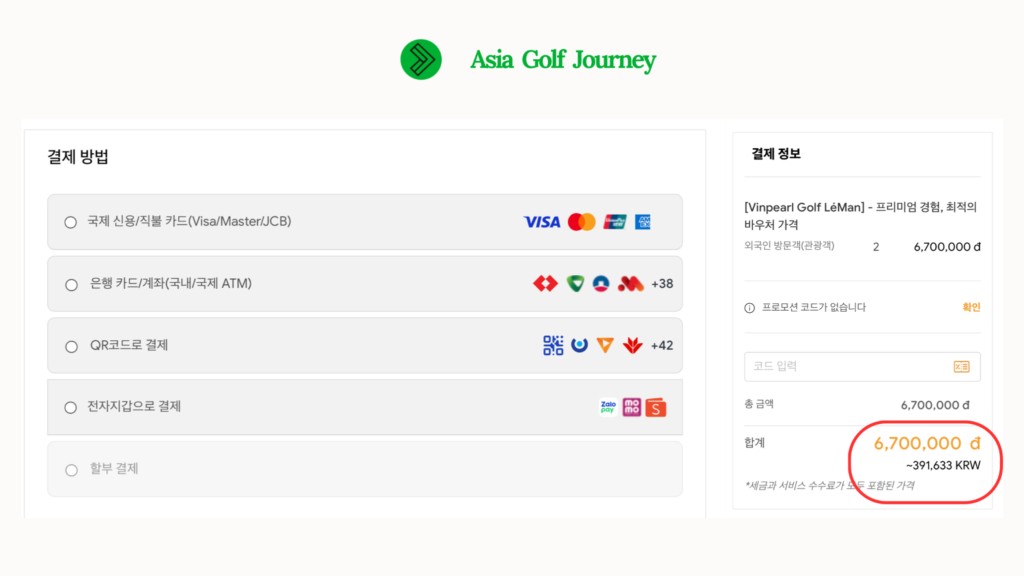
Real-time currency conversion rates for Korean guests on website of VinPearl Golf, Vietnam
Building a digital ecosystem that flawlessly balances high-end aesthetics, complex golf booking logic, and multi-border technical architecture requires a partner who understands both code and the game. Asia Golf Journey is uniquely positioned to develop your premium multi-language platform for the following reasons:
Asia Golf Journey isn’t just a generic software agency, we are golf and hospitality specialists. We understand the specific nuances of the golf industry. We design digital paths tailored specifically to the behavior of premium golf travelers.
We reject automated Google Translate widgets that ruin luxury brand positioning with broken golf terminology. Asia Golf Journey collaborates with native golf marketing experts to ensure that your course descriptions, luxury packages, and playing regulations are translated with absolute cultural precision and correct golfing nomenclature.
Partner with Asia Golf Journey today to transform your digital platform into a high-converting, world-class asset that speaks the language of the world’s most affluent golfers.
Email: creative@asiagolfjourney.com
Phone: +84 982 117 466
Website: www.asiagolfjourney.com
Asia Golf Journey – Trusted Marketing Partner for Successful Golf Leaders
#GolfMarketing #WebsiteDesign2026 #AsiaGolfJourney #VietnamGolf #WebsitePackage #HotelWebsite #DigitalMarketingPackage