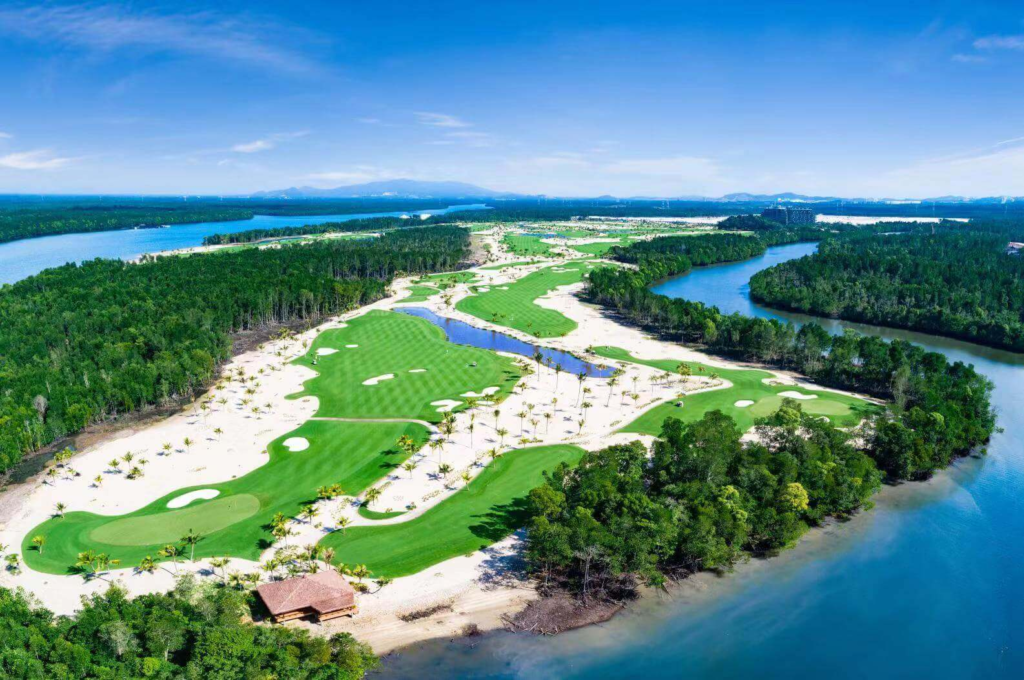
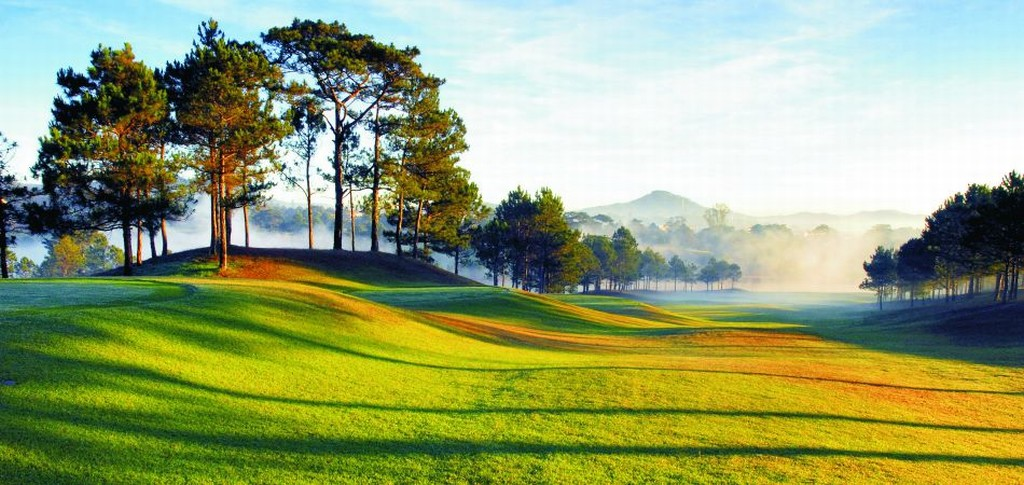
71 named golf destinations operating 84 active layouts 68 standard 18-hole and 16 extended 27-hole courses across 3 regions. Asia Golf Journey’s July 2026 research report on Vietnam’s golf course landscape.
Overview: Vietnam’s golf landscape in mid-2026
Vietnam’s golf market has matured significantly over the past decade. From a handful of courses concentrated around Hanoi and Ho Chi Minh City in the early 2000s, the country now counts 71 named golf destinations operating 84 active layouts across all three major geographic regions, comprising 68 standard 18-hole and 16 extended 27-hole courses. This positions Vietnam as one of the most course-dense golf destinations in Southeast Asia by both facility count and total hole capacity.
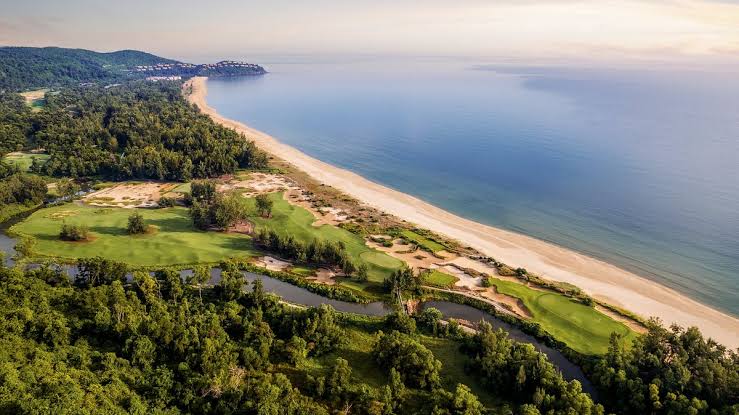
The country has received international recognition to match: Vietnam has been named the World’s Best Golf Destination at the World Golf Awards multiple times, with Da Nang’s central coastal corridor widely regarded as one of the highest-quality clusters of golf courses in all of Asia. That recognition is now translating into sustained inbound golf tourism demand, particularly from South Korea, Japan, and mainland China.
This report, compiled by the Asia Golf Journey research team as of July 2026, takes a more precise approach to measuring Vietnam’s golf supply than a simple course count. Following the methodology used by the National Golf Foundation (NGF) in its annual Golf Facilities in the U.S. report, we categorise Vietnam’s golf inventory by number of holes, not just facility count, to give operators, investors, and travel planners a more accurate picture of actual playing capacity.
Research methodology: This report counts active golf facilities open to public or member play as of July 2026. Where a single facility operates multiple layouts (e.g. 36-hole or 54-hole complexes), each layout is counted separately for hole-count analysis. Courses under construction are listed separately. Data compiled by Asia Golf Journey from operator disclosures, reliable sources, and connections. Total hole count and facility count may differ depending on the unit of measurement used.
Questions about this data or interested in a custom research report? asiagolfjourney@gmail.com · +84 982 117 468 · asiagolfjourney.com
How we count: facilities vs. holes
A common point of confusion in Vietnam golf reporting is the difference between a “course” and a “facility.” A facility like BRG Kings Island Golf Resort in Hanoi operates three distinct 18-hole layouts (Lakeside, Mountain View, and The King), making it one facility but three courses. PGA Ocean Golf Phan Thiet operates a 36-hole facility. Phoenix Golf Resort in northern Vietnam has 54 holes across three layouts.
Counting only facilities understates Vietnam’s actual golf capacity. Counting only 18-hole equivalents overstates the number of independent destinations. Both metrics matter depending on what question you are answering.
This distinction matters commercially. A 54-hole facility like Phoenix Golf Resort or BRG Kings Island can serve significantly more rounds per day than a standard 18-hole course, support a much larger membership base, and absorb group and corporate event demand that a single-layout course cannot. When evaluating market capacity or competitive positioning, hole count is the more accurate unit than facility count.
=> Get marketing ideas: https://asiagolfjourney.com/branding-and-marketing-solutions-for-golf-hotel/
Regional distribution: where Vietnam’s 84 layouts are located
Vietnam’s geography naturally divides its golf landscape into three distinct regions, each with its own climate window, design character, and visitor profile. The 84 active layouts are distributed across regions as follows:
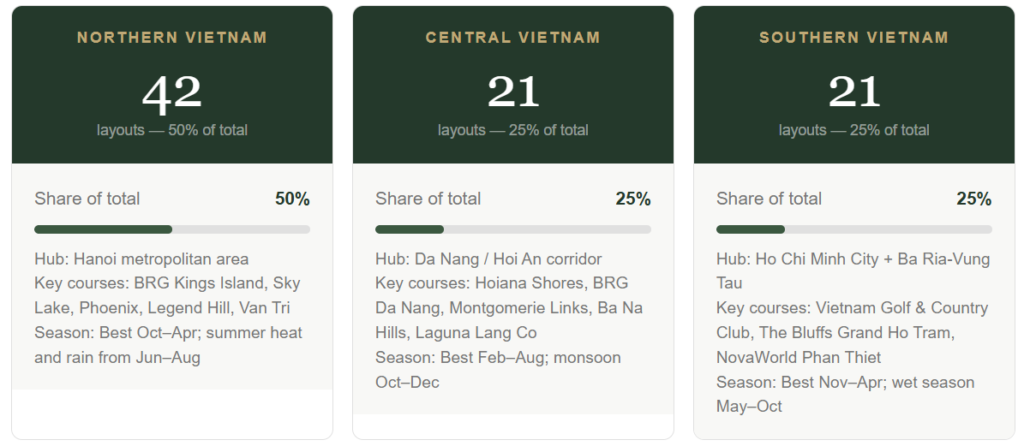
Northern Vietnam leads with 42 layouts, exactly half of the national total, primarily driven by the concentration of development around Hanoi, where corporate membership demand and proximity to the capital’s business community have supported a high density of courses within 60–90 minutes of the city centre.
Central Vietnam holds 21 layouts (25% of total) but punches well above its course count in terms of quality and international profile. The Da Nang corridor, roughly 60km of coastline from Hoi An to Laguna Lang Co, contains several courses that consistently rank among the top 100 in Asia, attracting a disproportionate share of international golf tourism relative to its share of total inventory.
Southern Vietnam also counts 21 layouts (25% of total), hosting some of the country’s highest-profile courses, including The Bluffs Grand Ho Tram, consistently ranked among Vietnam’s and Asia’s finest, and the Vietnam Golf & Country Club, the original prestige address in the south. The south also has the active development pipeline, with the Mekong Delta set to receive its first international-standard course at Cồn Ấu by 2027.
Major corporate operators: who controls Vietnam’s golf inventory
A defining feature of Vietnam’s golf market is the significant concentration of course ownership among a small number of large corporate groups. Six operators collectively account for 27 of Vietnam’s 71 named golf destinations approximately 38% of all named facilities. Understanding this operator landscape is essential context for anyone investing in, partnering with, or competing against Vietnam’s golf sector.
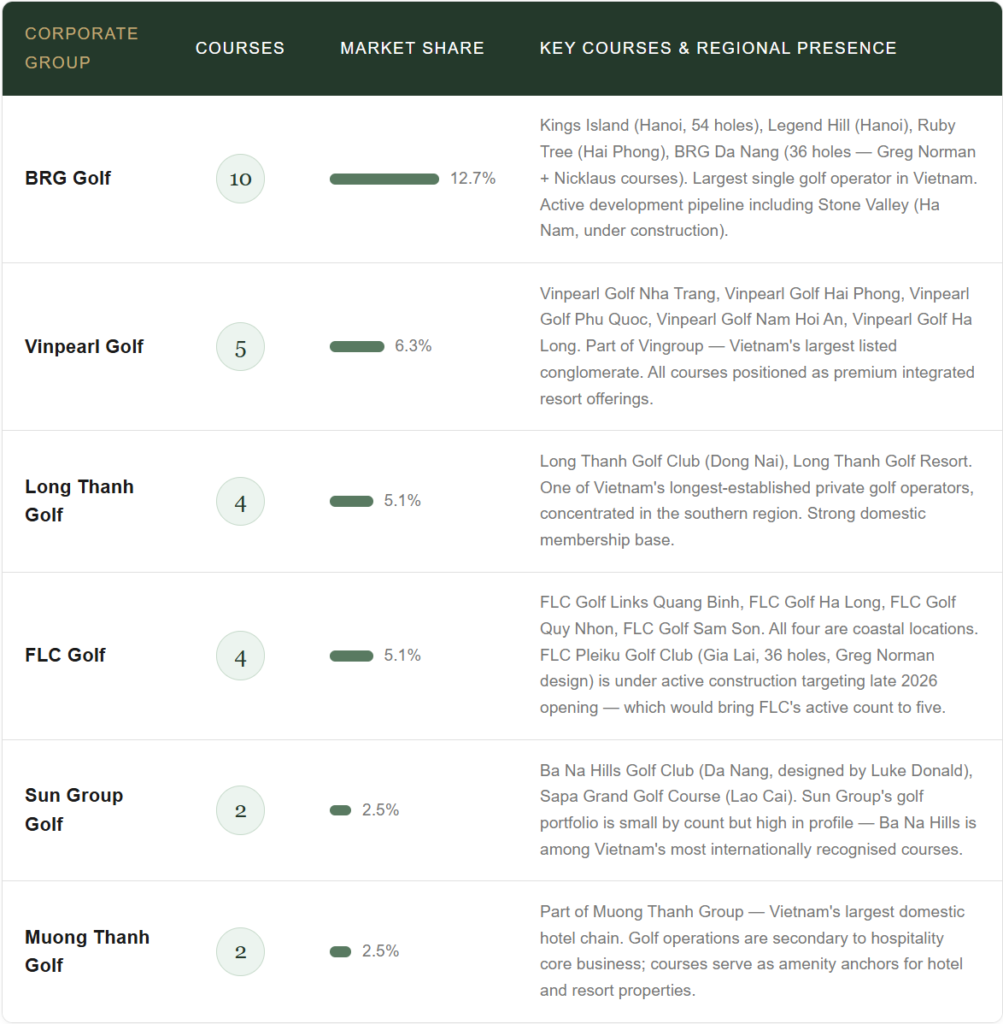
BRG Golf stands alone as Vietnam’s largest golf operator 10 active courses across 3 regions, with an active development pipeline. The gap between BRG and the next largest operator (Vinpearl at 5 courses) reflects BRG’s decade-long strategic focus on golf as a core business, not a resort amenity.
(Vietnam Golf Courses Update – July 2026 – Asia Golf Journey Research)
What the numbers tell us: four observations for 2026
The north is volume – the centre is value: Northern Vietnam has 42 layouts, exactly 50% of the national total, but a smaller share of international golf tourism revenue. Central Vietnam’s 21 layouts, particularly the Da Nang cluster, generate a disproportionate share of high-spend inbound visits. Course count does not equal market weight in Vietnam’s golf economy.
The south is the growth frontier: Southern Vietnam has the lowest course count (18) but the most active new development pipeline, including the Cồn Ấu Golf Course in Cần Thơ (Vinpearl, Greg Norman design, targeting 2028) and multiple projects in the greater Ho Chi Minh City catchment. The south’s share of total inventory is likely to increase meaningfully by 2028–2030.
Corporate concentration is deepening, not easing: The six major operators control 27 of 71 named golf destinations, 38% of all facilities by name. With BRG, FLC, and Vinpearl all having active development projects, that concentration is likely to increase. Independent and single-property operators face increasing competitive pressure from groups with marketing scale, brand recognition, and cross-property loyalty programmes.
Designer credentials are becoming a baseline expectation: IMG Design, Greg Norman, Jack Nicklaus, Nick Faldo, Robert Trent Jones II, Luke Donald, Colin Montgomerie, Vietnam’s active course portfolio reads like a roll call of world-class design talent. For new projects entering the market from 2026 onwards, a named international designer is increasingly a minimum credibility requirement for attracting serious golf tourism attention.
Questions about this data or interested in a custom market research report for your brand? asiagolfjourney@gmail.com · +84 982 117 468 · asiagolfjourney.com
Under construction: 144 new holes entering the market

Two of the five projects are particularly significant from a market development perspective: FLC Pleiku opens the Central Highlands, a region with no prior resort-grade golf, to the national and international golf map, while Cồn Ấu brings the Mekong Delta into Vietnam’s golf tourism orbit for the first time. Both carry Greg Norman design credentials, raising the baseline quality expectation for what a new Vietnamese golf destination should deliver.
The 54-hole Khoai Châu project in Hung Yen is the largest by hole count and, if completed as planned, would represent one of the most significant additions to northern Vietnam’s golf capacity since BRG Kings Island’s expansion. And especially the 12 golf courses in the supplementary plan for the Ha Long area.
Asia Golf Journey will update this research each quarter as construction milestones and opening timelines become clearer. Register below to receive updates directly. https://asiagolfjourney.com/contact/
Get Vietnam & Southeast Asia Golf News Delivered Monthly
New course openings, market data, operator updates, and golf travel intelligence, compiled by the Asia Golf Journey research team and sent directly to your inbox every month.
Questions about this data or interested in a custom research report? asiagolfjourney@gmail.com · +84 982 117 468 · asiagolfjourney.com
#VietnamGolf #GolfMarketData #GolfCoursesVietnam #BRGGolf #VinpearlGolf #FLCGolf #SunGroupGolf #VietnamGolfResearch #AsiaGolfJourney #GolfInvestmentVietnam #SoutheastAsiaGolf #Asiagolfjourney
Disclaimer , Asia Golf Journey Research, July 2026
Data: Compiled from operator disclosures, and direct verification. No single official database exists in Vietnam, figures are best estimates and may differ from other sources.
Methodology: The figures of 71 destinations and 84 active layouts reflect two distinct units of measurement: 71 counted by named facility, 84 counted by total playable layouts including multi-layout complexes. Courses under construction are listed separately and excluded from the active count.
This report is published for general market reference purposes. Asia Golf Journey assumes no obligation to verify, cross-reference, respond to enquiries, or update any content following the date of publication.
Timelines: Construction and opening dates are based on publicly available announcements as of July 2026 and are subject to change. Asia Golf Journey does not warrant that any projected date will be met.
Usage: Free to share with attribution to Asia Golf Journey. Commercial reproduction requires prior written permission. Contact: asiagolfjourney@gmail.com