In today’s digital-first golf industry, your website isn’t just a digital brochure. Yet, research shows that the majority of golf course website mistakes still occur that frustrate visitors and drive them to competitors.
Let’s explore the four most damaging website mistakes that elite golf courses are eliminating in 2026 and how a strategic website optimization approach can transform your digital presence into a revenue-generating asset.
Mistake #1: Suboptimal redirection & Traffic leakage to third-party platforms
The problem: Many elite golf courses spend a lot of money on marketing to drive premium guests to their official website. However, they make a basic operational mistake: When a golfer clicks the main “Book Now” button, instead of keeping them on the site to process the booking directly, the website redirects them entirely away to an outside booking platform or third-party agency.
The Impact:
By sending visitors away, your website is essentially running free marketing and generating free leads for other platforms.
- Giving away premium guest data: Instead of keeping the golfer on your site to collect valuable data like their email, phone number, and booking habits for future promotions, you are handing all that asset data over to an outside system.
- Losing upsell opportunities: Once the guest is pushed to an external platform, you lose the chance to sell add-on services that increase revenue per player, such as pre-booking clubhouse dining, premium rental clubs, or VIP transport.
- Cutting into direct revenue: The course loses control of the booking journey and is forced to share profit margins or rely on outside technology, instead of capturing 100% of the direct booking revenue.
Real-world case study:
A highly prestigious championship golf course in Southest Asia serves as an example of how this integration mistake compromises digital revenue. The club successfully invests in high-end brand marketing to drive wealthy golfers to its official web platform. However the booking engine revealed that the club completely outsources via an external plugin: “booking technology powered by Golfscape”.
Despite the interface being seamlessly branded to match the club’s aesthetic, this reliance on an outside provider triggers severe financial and operational leakages:
- Complete data asset leaking: When a premium golfer books a tee time, their most valuable digital assets (direct contact info, email, phone number, and real-time spending behavior) are captured and stored on the external provider’s servers. The club loses direct ownership of this data, making its ability hard to run automated, direct remarketing campaigns for future promotions.
- Decrease of direct profit: Even though the customer was acquired through the golf club’s own marketing efforts and website traffic, the course is forced to share profit, split commissions, or pay transaction fees to an outside technology vendor for a booking that should have been 100% direct revenue.
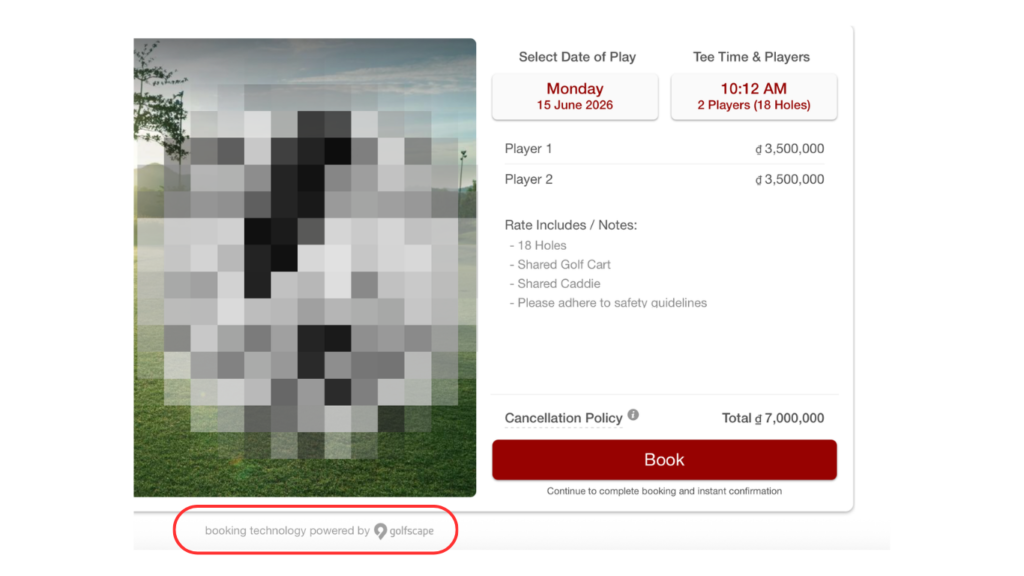
Mistake #1: Suboptimal redirection & Traffic leakage to third-Party platforms
Mistake #2: Lorem ipsum placeholder text & unfinished golf course website mistake
The problem: Your website features Lorem ipsum placeholder text scattered throughout pages (course descriptions, testimonials, membership sections,..). This signals the website was abandoned mid-development or poorly maintained. For a premium golf experience, incomplete content sends a clear message: we don’t care about details.
The impact: Visitors immediately question the course’s professionalism. If you can’t finish a website, can you maintain the course? They abandon the site within seconds. Lorem ipsum text is digital neglect, it erodes years of on-course reputation and makes potential guests assume the course is either closed, under new management, or financially struggling.
Real-world case study: A well-known golf club in Southeast Asia recently updated its website but left its most critical marketing feature (the “Signature hole” showcase) unfinished with default Latin filler text (“Lorem ipsum dolor sit amet…”) as shown in the image below. When high-spending golfers encounter broken placeholder text on a course’s most iconic feature, it instantly shatters the luxury illusion. This impression of digital neglect drives premium guests straight to competitors whose websites actually match their on-course standards.
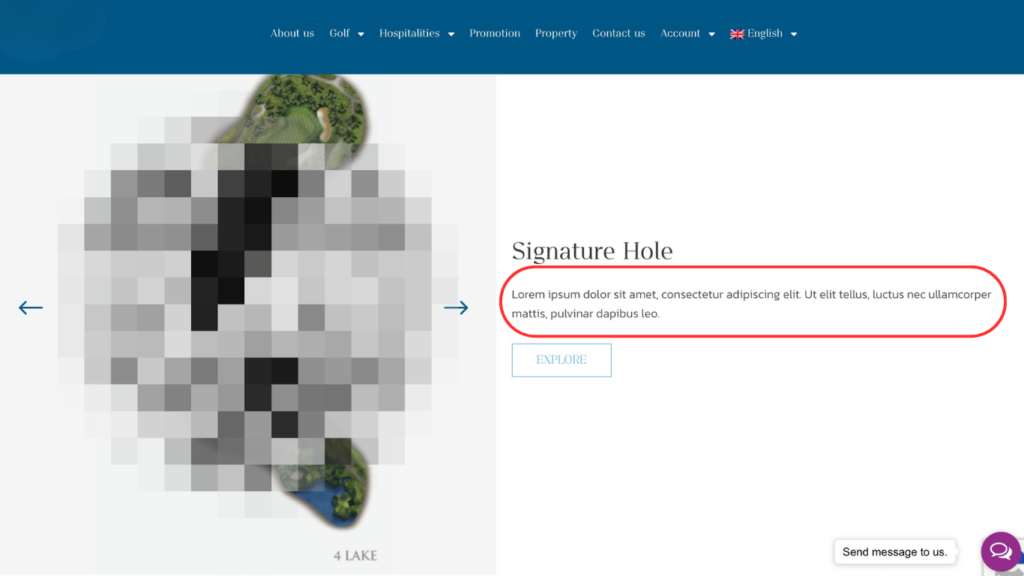
Mistake #2: Lorem ipsum placeholder text & unfinished golf website
Mistake #3: Zero mobile optimization
The problem: Your golf course website may look sharp on desktop, but on mobile devices (which account for 69.9% of global website traffic according to the Digital Experience Benchmark Report 2026 from Contentsquare), it’s slow, unresponsive, or nearly impossible to navigate. This results in a broken user experience:
- Micro-targets: Calendar grids and tee-time slots designed for mouse clicks become impossibly small for human thumbs, causing frustrating misclicks.
- Excessive data fields: Forms demand endless scrolling and manual typing, which is a major deterrent for a user on the move.
- Layout shifting: Booking engines and payment gateways fail to scale responsively, clipping critical text or hiding the “Next” button entirely.
The impact on golfer behavior:
When a mobile experience fails, you aren’t just losing a page view; you are handing a high-value customer directly to your closest competitor.
- The instant bounce: Modern golfers, especially premium travelers booking golf trips, demand immediacy. If the interface feels sluggish or clunky, instead of trying to “figure out” your site, they abandon it within seconds.
- Friction during the checkout process: If the checkout page feels unsecure, or requires re-entering credit card details on a non-responsive form, guests’ trust may erode instantly.
- The competitor pivot: The moment a golfer leaves your site in frustration, they return to Google and search for alternative courses. They will happily book another prestigious course if that competitor’s golf course website allows them to secure a tee time flawlessly on their phone.
Real-world case study: We tested a Thailand golf course website on Google PageSpeed Insights and scored 43/100 for mobile version. The first element takes 9.9 seconds to appear on mobile (3x slower than Google’s 3-second recommendation), and the full page takes 13.9 seconds to load. When potential golfers land on the site via Google Search, they wait nearly 10 seconds for any content to display. By second 5, most have bounced to a competitor with a faster site. According to Google, 53% of mobile users abandon sites taking longer than 3 seconds, meaning this prestigious course is losing more than half its mobile traffic before visitors even see the homepage, not because they don’t want to play, but because the website is frustratingly slow on phones.
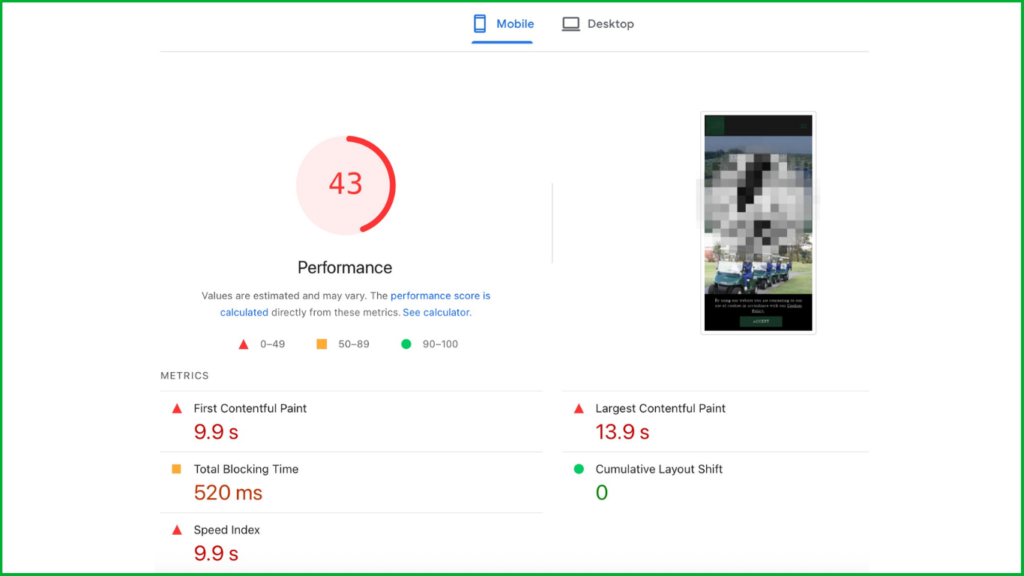
Mistake #3: Zero mobile optimization for golf website
Recommended solutions:
- Streamlined “thumb-only” booking flows: Reduce the registration form to the absolute bare minimum. Incorporate autofill capabilities so golfers can complete their reservation with minimal typing.
- Native mobile wallet integrations: Eliminate the need for players to pull out physical credit cards. Integrate one-tap payment methods like Apple Pay, Google Pay, and localized digital wallets directly into the mobile checkout screen to completely eliminate friction.
Mistake #4: Static rate cards & no interactive booking interface
The problem:
According to Intel Market Research, 37% of traditional golf facilities continue to rely on manual booking systems, meaning that the premier golf courses still rely on manual processes or legacy systems. Especially, many golf courses across Southeast Asia continue to display pricing as static tables (dense, non-interactive grids showing all rate combinations across guest categories). Golfers cannot check real-time availability, select a date to see pricing, or calculate total costs with add-ons (caddy, buggy, club rental). They must call the pro shop or email to book.
The Impact on golfer behavior:
When a golfer views a static rate card, they encounter many obstacles during the booking process:
- Unnecessary time consumption: Normally, a golfer spends 5-10 minutes attempting to decode a rate card to determine which price applies to their situation. They must cross-reference multiple variables: guest type (member/public), day of week, seasonality, and gender. For mobile users, this task is compounded by small screens and the difficulty of navigating dense tables on narrow viewports.
- Hidden fees erode trust: In Fullstory’s 2026 survey on booking behavior, 61% of consumers cited hidden fees as the leading reason for abandoning bookings, while 31% left due to last-stage price changes. At golf courses, this manifests when golfers discover add-ons at the payment stage: caddy ($15–25), golf cart ($10–15), and club rental ($20–30) fees that were not clearly itemized upfront.
Real-world case study: Many Southeast Asian championship courses rely on static PDF rate cards rather than live booking tools – a cumbersome process modern golfers avoid. Forward-thinking competitors deploy interactive rate calculators: select date → choose guest type → see real-time availability → instant total pricing → book in 60 seconds.
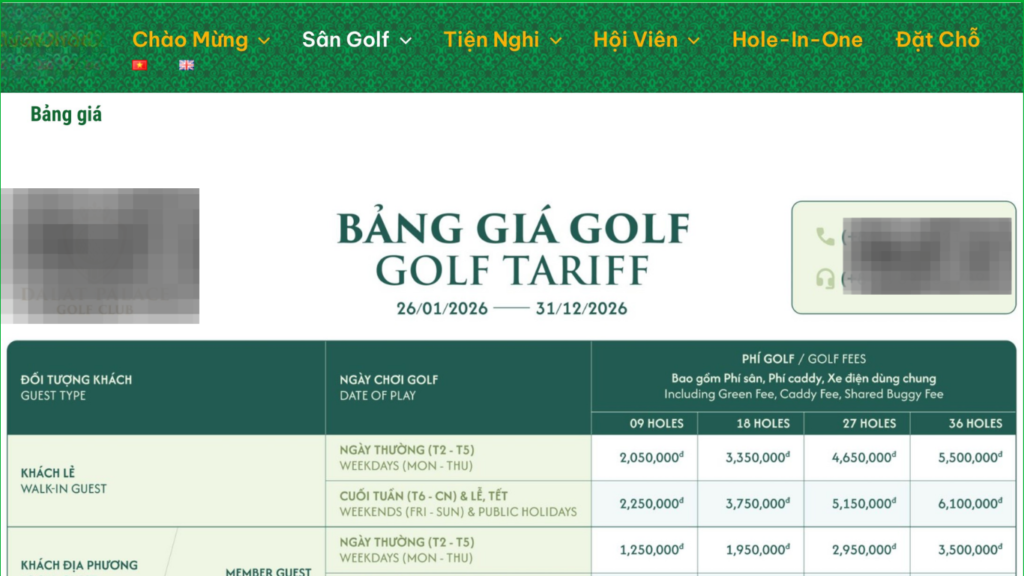
Mistake #4: Static rate cards by PDF & no interactive booking interface
Recommended solutions:
Forward-thinking golf courses should deploy:
- Dynamic rate calculators that update based on real-time demand and availability
- Instant availability confirmation after golfers select a date
- Clear fee disclosure before payment processing (no hidden costs)
- One-tap payment options (Apple Pay, Google Pay, stored cards) to reduce friction
The path forward: Strategic website optimization
Elite golf courses in Asia are addressing these mistakes with a comprehensive website strategy that goes beyond cosmetic updates. They’re investing in:
- Complete content audit & professional copy: Removing placeholder text, unfinished pages, and broken links; replacing generic messaging with polished, course-specific content that builds credibility and trust
- Mobile-first responsive design: prioritizing seamless navigation and fast load times across all devices; sticky booking buttons and simplified checkout flows optimized for mobile golfers
- Interactive rate calculator & real-time booking integration: Replacing static rate tables with dynamic pricing tools where golfers select date, guest type, and add-ons to instantly see availability and total cost, then book in seconds. (See how global golf courses ultilize AI into pricing tool on their website).
Is your website making these mistakes?
The golf industry is evolving rapidly. Courses that fail to modernize their digital presence are losing traction to competitors who understand that a website is a 24/7 sales and marketing tool, not a digital billboard.
Asia Golf Journey specializes in transforming golf course websites into revenue-generating assets. Our comprehensive website optimization package addresses every mistake listed above and more.
What you’ll receive:
- Complete technical audit of your current website
- Mobile-optimized redesign with intuitive booking flow
- SEO strategy & implementation (technical, on-page, content)
- Training & ongoing optimization support
Ready to stop leaving revenue on the table?
Get in touch and we will help you build a high-converting website that turns browsers into confirmed players.
Email: creative@asiagolfjourney.com
Phone: +84 982 117 466
Website: www.asiagolfjourney.com
Asia Golf Journey Trusted Marketing Partner for Successful Golf Leaders
#GolfMarketing #WebsiteDesign2026 #AsiaGolf #GolfLeader #AsiaGolfJourney #VietnamGolf #WebsitePackage