The courses are here. The visitors are coming. The rankings are improving. But a destination without a signature is just a stop on someone else’s itinerary and there are a thousand stops in this game.
There is a version of Vietnam’s golf story that sounds like a success. Record international visitors keep growing after pandemic. Award-winning courses every year. A ranking in Golf World’s global Top 100. World Golf Awards naming Vietnam the world’s best golf destination some years running. Developers breaking ground on new layouts from Hanoi, Quảng Ninh to Pleiku, Nha Trang, Ho Chi Minh to Phú Quốc Island. By almost any measure available, the numbers are moving in the right direction.
And yet, standing here watching this market grow from the inside, there is a question that the numbers do not answer, and that nobody talks about loudly enough: when a golfer anywhere in the world opens their laptop to plan a serious golf trip, do they think of Vietnam? Or do they think of Scotland, Ireland, Spain, Thailand, Japan, Australia and only arrive at Vietnam after scrolling past a dozen other options first?
That gap between what the data says and what actually happens in a golfer’s decision-making process is where Vietnam’s real challenge lives. And it will not be resolved by building one more course, winning one more award, or generating one more year of visitor growth statistics.
“A destination without a signature is just a stop on someone else’s itinerary. And in world golf, there are a thousand stops.”
The world is not short of golf destinations

This is the context that Vietnam’s golf industry does not always sit with long enough. There are over 35,000 golf courses in the world. More than 100 countries have a functioning golf industry. Somewhere between 60 and 80 countries are actively marketing themselves as golf tourism destinations to the same audience of serious travelling golfers.
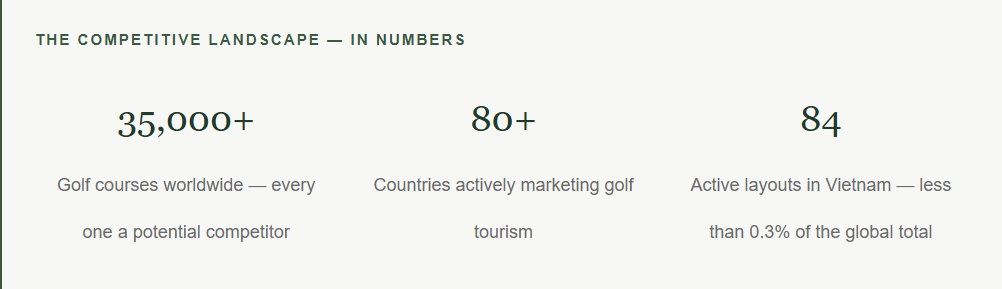
Number of Golf Courses in Vietnam updated 2026
Scotland has St Andrews, Muirfield, Royal Dornoch, Turnberry, Carnoustie, Kingsbarns and a cultural story about the birthplace of the game that no marketing budget can replicate. Ireland has its wild links coast. The United States has Pebble Beach, Augusta, Pinehurst. Australia has Royal Melbourne and the Sandbelt. Japan has a golf culture so distinct and disciplined that even its courses feel like a different version of the sport.
Every one of these places has something that a serious golfer would say, without hesitation, is the reason to go there, the thing they could not get anywhere else. Scotland is the origin. Ireland is the wild coast. Japan is the precision. Australia is the sandbelt. These are not marketing taglines. They are real, felt, distinct identities that exist in the mind of the travelling golfer before the trip is even planned.
Now: what is Vietnam?
What we have built and what we have not yet named
Vietnam has built genuinely world-class infrastructure. The Bluffs Grand Ho Tram is a legitimate global top-ranked course by any serious metric. Hoiana Shores, designed by Robert Trent Jones II, holds its position in Golf World’s Top 100 and would be competitive in any regional ranking. Ba Na Hills won Asia’s Best Golf Course some consecutive years and brought Luke Donald’s name to a mountainside above Da Nang, managed by IMG. Legend Da Nang placed two Greg Norman and Jack Nicklaus layouts side by side on a sand dune coastline. And FLC Pleiku is now breaking ground on a 36-hole highland layout, the first resort-standard course in the Central Highlands that could genuinely open a new chapter in what Vietnamese golf looks and feels like.

This is real. This took decades of investment, real risk, real vision from developers, operators, and the local authorities who backed these projects. None of it should be minimised.
Caddie Tips Guide in SouthEast Asia Countries 2026
But here is what has not happened alongside it: Vietnam has not yet produced a clear, felt answer to the question every travelling golfer asks, consciously or not, when they choose a destination. Why here, and not somewhere else?
“We have built the infrastructure of a great golf destination. We have not yet told the world clearly, confidently, repeatedly what kind of golf destination we are. That gap is not a communications problem. It is a strategic one.”
The awards help. The rankings help. But awards and rankings tell a golfer that Vietnam is good. They do not tell a golfer what Vietnam is. And in a world where the serious travelling golfer has 80 countries to choose from, all of them capable of citing awards and visitor numbers, “we are good” is not a reason to book a flight.
The risk of staying generic
There is a trajectory that many golf destinations have followed. They build courses, attract visitors, accumulate awards, improve infrastructure, report growing numbers and at some point realise that they have become very successful at being a generic option. A good-value destination. A nice alternative. Somewhere to go when Scotland is too cold or Spain is too crowded.
That is not nothing. But it is also not a signature. And a destination without a signature is structurally vulnerable because the generic position is the most competitive one. Every new course built in Thailand, Indonesia, or the Philippines makes the generic “affordable Asian golf” position more contested, not less.
Vietnam’s Central Coast corridor, roughly 100km from Da Nang to Hội An, may be the most concentrated stretch of internationally ranked golf in all of Southeast Asia. That is a real, specific, distinctive thing. It is the closest equivalent in this region to what the Algarve is to European golf, or what the Monterey Peninsula is to American golf. A corridor. A cluster. A reason to come to a specific place, not just a general region.
“Vietnam’s Central Coast is the closest thing Southeast Asia has to a world-class golf corridor. That is not a small thing. It is just waiting to be named, told, and owned.”
But we have not fully named it, told it, or owned it. We talk about individual courses. We celebrate individual awards. We promote individual resorts. The story of the corridor, the cumulative, sequential, multi-course experience that Vietnam offers in a way that nowhere else in this region can, remains largely untold at the level where it would actually change a golfer’s decision.
What a signature could look like
Building a golf identity is not about choosing a slogan. It is about deciding, at an industry level, what Vietnam is going to be the world’s best place to do and then aligning everything: course development, service standards, marketing investment, media relationships, and the on-the-ground experience around that decision.

None of the signature elements in that right-hand column are invented. They are real. They are true. They are distinct. The difference is that nobody has committed to telling that story at scale, consistently, across every channel where the serious travelling golfer makes decisions.
The people watching this place grow
This is where the view from inside the market matters because the numbers tell one story and the feeling on the ground tells another.
The feeling, from here, is of a market that is genuinely exceptional in its raw materials and genuinely underpowered in its sense of itself. Vietnam’s golf industry has been built largely by resort developers, construction companies, international operators. Each has made their own investment, told their own story, built their own brand. The result is a collection of excellent individual assets without a collective voice.
When a Korean golfer lands in Da Nang and there are more Korean golfers landing in Da Nang than ever before, 4.3 million Korean visitors came to Vietnam in 2025. And if they play golf, they have usually already booked their tee times, arranged their transport, chosen their restaurant, and planned their trip through a Korean travel agent who packages the whole thing as a commodity. They may have a wonderful experience. They may come back. But the relationship the identity, the story, the meaning of the place belongs to the packaging agent, not fully to Vietnam.
That is the gap. Not the courses. Not the quality. Not the rankings. The gap is between the experience Vietnam delivers and the story Vietnam tells about itself. A story told by others, in their language, for their purposes, will always position Vietnam as the destination rather than the protagonist.
“The golfers are coming. That part is working. But if we are not the ones telling the story of why they came, what this place is, what it offers that nowhere else can we are just another line on someone else’s itinerary. And in a world of a thousand destinations, that is not where this market deserves to be.”
What the next five years could decide
Vietnam’s golf market is at an inflection point. Five new projects are under construction, adding 144 holes to the national inventory. Hoiana Shores is in a global top-100 ranking and gaining genuine attention from international golf media. Inbound numbers from Korea, Japan, and increasingly China are strong. FLC is pushing its Pleiku highland project at pace, with local government support and a target of welcoming its first golfers before the end of 2026. The infrastructure is maturing faster than the identity around it.
The decision that gets made, or not made, in the next five years is whether Vietnam’s golf industry comes together around a shared identity, or continues to grow as a collection of individual assets each competing for the same pool of visiting golfers. Both paths produce growth. Only one produces a destination that a golfer anywhere in the world would put at the top of their list before they even consider the alternatives.
The courses are here. The land is exceptional. The people who work in this industry, from the greenkeepers at Ba Na Hills at 4am preparing the greens, to the caddies at The Bluffs who know every ridge and wind-shift on that coastline, to the construction teams at FLC Pleiku preserving bonsai pines around a layout that no other country in the region could build, are doing something that deserves to be the centrepiece of a global golf story, not a footnote in someone else’s Asia travel package.
Naming that story. Owning it. Telling it consistently, in the right places, to the right people, that is the work that turns a golf destination into a golf identity. And Vietnam has everything it needs to do it. The question is whether the industry decides to.

Asia Golf Journey is based in Vietnam and works with golf courses, resorts, and operators across Vietnam and Southeast Asia on marketing strategy, content, and market development. This article represents the editorial perspective of Asia Golf Journey based on direct experience of the Vietnam golf market. Data referenced: Golf World Top 100 Courses You Can Play 2026; General Statistics Office of Vietnam; Asia Golf Journey Market Research, July 2026; Lightspeed Golf Industry Trends Report 2025.
#VietnamGolfIdentity #GolfDestinationStrategy #SoutheastAsiaGolf #GolfMarketingVietnam #GolfTourismOpinion #DaNangGolf #Corridor #AsiaGolfJourney #VietnamGolf 2026