For years, Booking.com, Agoda, and Expedia have been the backbone of distribution for hotels and resorts. But as commission fees keep climbing and traveler search behavior keeps shifting, more and more properties are shifting their attention toward converting direct bookings through their own website not as a nice-to-have, but as a genuine growth strategy.
A well-built website doesn’t just reduce OTA dependency. It also gives a property a real edge in getting discovered both through traditional search engines and through the AI platforms travelers are increasingly turning to. Guests now research destinations on Google, Google AI Overviews, ChatGPT, or Gemini before they ever land on a hotel’s own site. So the real question for any property today isn’t “do we have a website?”, it’s “can our website actually be found by both customers and AI?”
That’s why SEO (Search Engine Optimization) alone is no longer enough. To show up at every stage of a traveler’s search journey, golf and hospitality businesses now need to combine three layers of visibility: SEO, AEO (Answer Engine Optimization), and GEO (Generative Engine Optimization), which are the three pillars of discoverability in the AI-search era.
Connect to receive a free website audit from AGJ:
📞 +84 982 117 466
📧 creative@asiagolfjourney.com
1. SEO, AEO, and GEO: Three Strategies for Showing Up at the Moment of Decision
Not long ago, a traveler’s search journey was fairly linear: type a keyword into Google, click through a handful of websites, read some reviews, then book. That behavior is changing fast under the influence of AI search. Instead of only searching on Google, many travelers now ask ChatGPT, Gemini, or Google AI Overviews directly and get a synthesized answer in seconds. The questions are like:
- What’s a good golf resort for a family trip in Central Vietnam?
- Which golf resort is near Da Nang airport and offers a golf-and-stay package?
- Which golf courses in Vietnam suit Korean golfers best?
That shift means a property can no longer settle for just being findable on Google, it needs to become a source AI tools trust enough to reference and recommend. That’s exactly why SEO, AEO, and GEO now work as three complementary strategies rather than three separate tasks. None of them replaces the others; together, they cover the entire arc of a traveler’s search journey.
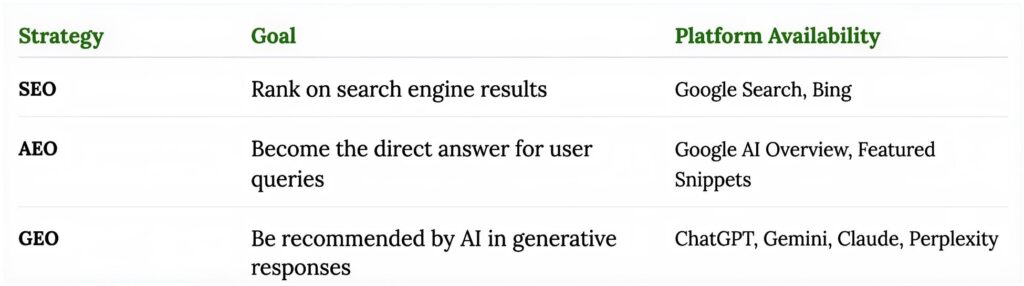
Comparison between SEO, AEO, GEO
SEO: The Foundation That Lets Customers Find You In The First Place
SEO is the process of optimizing a website so it ranks well when travelers search for information about a destination, hotel, or golf course. For hospitality and travel businesses, SEO isn’t just about ranking for terms like “golf resort Vietnam” or “5-star hotel Da Nang.” What matters more is building content that answers the questions travelers are actually asking before they decide:
- What’s the best season to play golf in Central Vietnam?
- A 5-day golf itinerary through Da Nang and Hoi An
- Golf courses that are beginner-friendly
- Comparing golf-and-stay packages in Central Vietnam
When a website consistently publishes content that’s genuinely useful, it earns organic traffic and builds trust with travelers from the very first stage of research, well before any booking decision is made. Google’s own guidance for modern SEO puts it simply: the goal is to create content that serves people, not search engines.
AEO: When Travelers No Longer Want To Dig For The Answer Themselves
If SEO gets your website found, AEO is what turns your brand into the answer itself. Google AI Overviews can now pull together information from multiple sources and answer a question directly, without the user ever clicking into an individual website. That raises the bar for how content needs to be built. Instead of repeating keywords, a property needs content that’s clearly structured, answers questions directly, and demonstrates real expertise on the topic.
Guides, FAQs, travel handbooks, and itinerary suggestions are exactly the kind of formats that lend themselves well to AEO.
GEO: Helping AI Understand And Recommend Your Brand
The rise of generative AI tools like ChatGPT, Gemini, and Claude marks a new phase of search. Instead of a list of links, these platforms pull information from multiple sources and generate one complete answer. So the goal isn’t just to rank on Google anymore — it’s to become a source credible enough for AI to reference and recommend by name.
That’s the job of GEO (Generative Engine Optimization). To increase the odds of being surfaced by AI, a website generally needs:
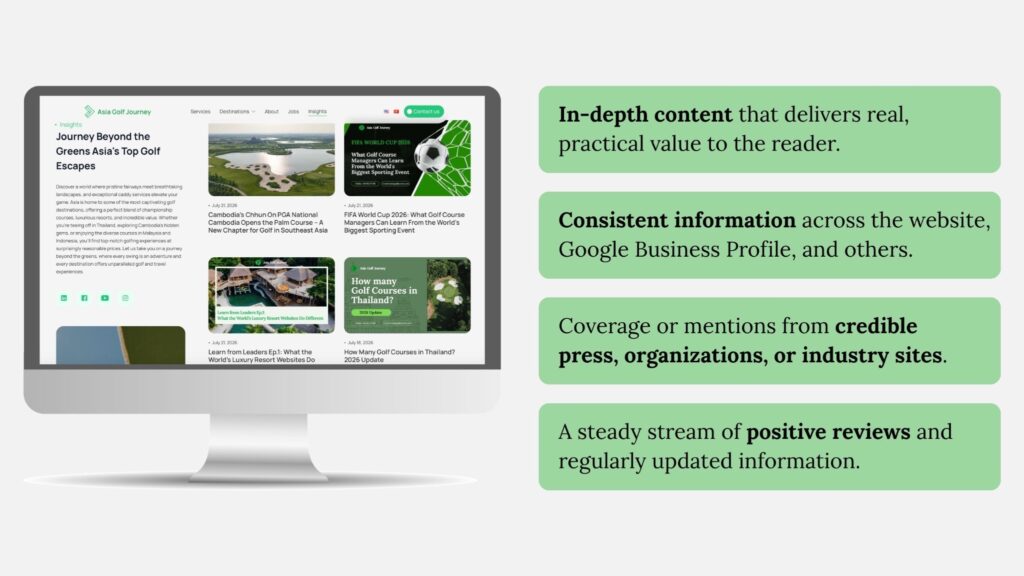
In other words, GEO isn’t a standalone technique, it’s the outcome of a comprehensive digital branding strategy. Google itself emphasizes that quality content should reflect E-E-A-T: Experience, Expertise, Authoritativeness, and Trustworthiness. These same principles are increasingly what AI models rely on to decide which sources to trust and cite.
Understanding what SEO, AEO, and GEO do is only step one, though. What actually matters is how a business puts them into practice. Many hotels and golf courses have started using AI to generate content, hoping it will boost rankings and traffic. In reality, AI is a tool, not a strategy. Used the wrong way, it can produce a lot of content while doing nothing for visibility on Google or AI platforms, and nothing for direct booking conversion either.
So what are the most common mistakes businesses make when they lean on AI for content?
2. Common Mistakes When Using AI to Build Content
Chasing volume over value
Many properties set a goal of publishing as many articles as possible, hoping it drives more organic traffic. But Google increasingly rewards content that genuinely solves a reader’s problem over a pile of articles that all say roughly the same thing with little real value. One deeply researched piece on a golf itinerary, how to choose the right golf resort, or the best time of year for a golf trip to Vietnam will build far more trust and drive more bookings than thirty generic posts ever will.
Content that lacks real, lived experience
AI can synthesize information from countless sources, but it can’t replicate the first-hand experience a business actually has. Take an article on “playing golf in Da Nang during the rainy season”, it becomes far more valuable when it includes the right time to play, actual weather conditions on the ground, insights from the course’s own operations team, and practical notes for international golfers. This is exactly the kind of content that reflects the “Experience” piece of Google’s E-E-A-T framework mentioned above.
Inconsistent information across channels
A website might present one message while Google Business Profile, social media, or review platforms show something different. That inconsistency makes it hard for both customers and AI tools to know which information to trust. To optimize for GEO, a business needs to keep core details (address, services, photos, phone number, website, brand messaging) aligned and up to date across every platform.
Investing in content while ignoring the website experience itself
Even great content won’t save a visitor from leaving if:
- The site loads slowly
- The mobile experience feels clunky
- The booking or tee-time button is hard to find
- The booking process itself is overly complicated
SEO, AEO, and GEO can bring travelers to a website but the actual user experience is what decides whether they follow through with a direct booking. That’s why the businesses leading in this space don’t treat SEO as a standalone activity. They treat it as one part of a broader digital transformation and customer-experience strategy.
Optimize your golf or hotel website with AGJ’s professional website design package:
📞 +84 982 117 466
📧 creative@asiagolfjourney.com
3. Case Study: How Amanoi (Vietnam) Optimized for SEO, AEO, and GEO
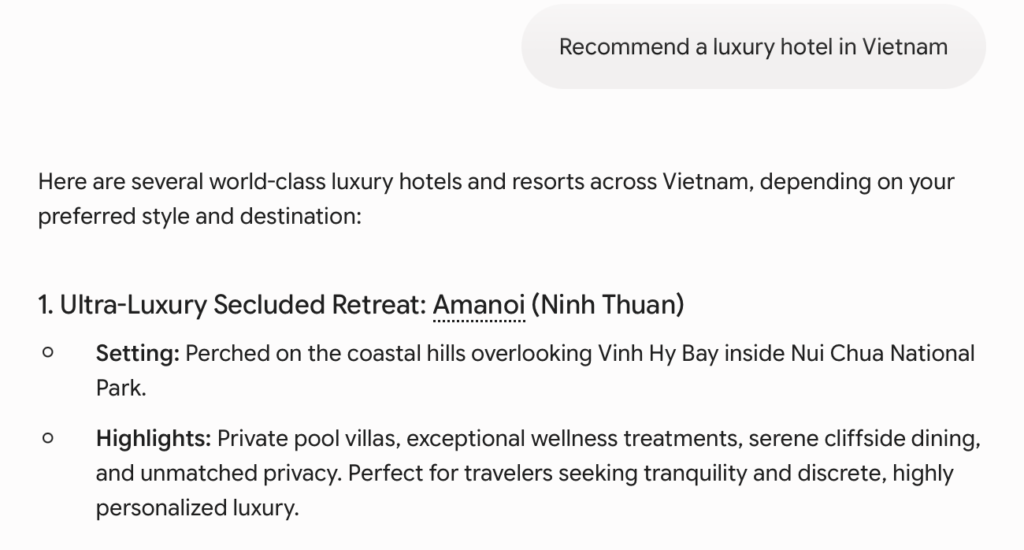
Example about how one resort optimizes for AEO
Ask Gemini to “recommend a luxury hotel in Vietnam,” and Amanoi is one of the first properties it suggests. What’s notable isn’t just that the name comes up, it’s how specifically the AI describes it: perched on the coastal hills overlooking Vinh Hy Bay, private pool villas, exceptional wellness treatments, serene cliffside dining, highly personalized luxury.
None of that description was invented by the AI. It was assembled from signals that Amanoi’s own website and broader online content ecosystem had already put in place.
SEO: a website built for Google to understand the story correctly
The first step to being recommended by AI is simply being well indexed by Google and other search engines. On Amanoi’s website, the SEO fundamentals are all clearly in place: page titles built around “luxury resort,” clean and descriptive URLs, meta descriptions that reflect the brand’s actual positioning, and content centered on location, the guest experience, and standout amenities. That combination helps Google understand Amanoi as a genuine luxury resort in Vietnam and builds the kind of authority AI systems draw on when generating an answer.
GEO: AI understands the property’s value because the content is well structured
This is where GEO really shows its impact. Compare Gemini’s answer with Amanoi’s own website, and almost every detail the AI uses traces directly back to the site itself.
Rather than relying on generic marketing lines like “experience ultimate luxury,” Amanoi’s website describes each experience, each amenity, and each point of differentiation in concrete, specific terms. That’s precisely the kind of content AI models can easily parse, synthesize, and reuse to answer a traveler’s question. In short, AI doesn’t just crawl the site, it actually “understands” it, because the information is organized clearly.
AEO: content that answers exactly what travelers are asking
Another reason Amanoi surfaces in AI results is that it directly answers what travelers are looking for. When someone asks “recommend a luxury hotel in Vietnam,” Amanoi’s website has already laid the groundwork through its overview pages, experience pages, spa, villas, dining, and wellness content. That lets AI assemble a complete answer without having to infer or guess. That’s the essence of AEO: build content that directly answers a traveler’s real questions and search intent, rather than optimizing purely around keywords.
Asia Golf Journey helps brands stay visible in the AI era
Amanoi’s case makes one thing clear: a golf course and hotel website can’t just look beautiful. It has to be built so Google and AI tools alike can understand it, trust it, and recommend it. Asia Golf Journey designs websites for golf courses, hotels, and resorts with SEO, GEO, and AEO built in from the start, helping brands show up on Google, ChatGPT, and Gemini, and turn that visibility into more direct bookings.
Get in touch with our specialists:
📧 Email: creative@asiagolfjourney.com
📞 Hotline: +84 982 117 466
The Leading Strategic Partner for Golf, Sports & Hospitality in Vietnam