Short video marketing strategy for hotels is becoming a vital part of digital marketing in 2026, as travelers increasingly discover destinations, seek inspiration, and evaluate experiences through TikTok, Reels, and YouTube Shorts. However, the challenge is not simply producing more videos, but building a content system that attracts the right audience, conveys the stay experience, and supports the room booking decision process. Drawing from international case studies like Hilton and Hoiana Resort & Golf, this article analyzes key highlights and transforms them into an actionable framework for hotels and resorts in 2026.
1. Hilton: Building a “Content System” Instead of Chasing Individual Viral Videos
The key lesson from Hilton is not a single video reaching millions of views, but how the brand transformed short-form video into a reproducible content system. Hilton did not start by asking “What video should we post today?”, but instead built content around a core thesis: the value of a trip lies not only in where you go, but in where you stay.
From the “Hilton. For The Stay” platform, the brand continuously transforms stay-related situations into diverse stories: expectations vs. reality when traveling, issues arising during a stay, memorable moments at the hotel, or the difference between a great stay and a poor one. This creates a vast topic pool compared to merely filming hotel facilities.
This approach is particularly notable from a short-form perspective: Hilton does not necessarily need a brand-new idea for every video. Instead, they take an insight regarding guest behavior or experience → turn it into a format → vary the situation → reuse the format multiple times. This is the difference between a channel that merely “posts videos” and one that operates a content system.
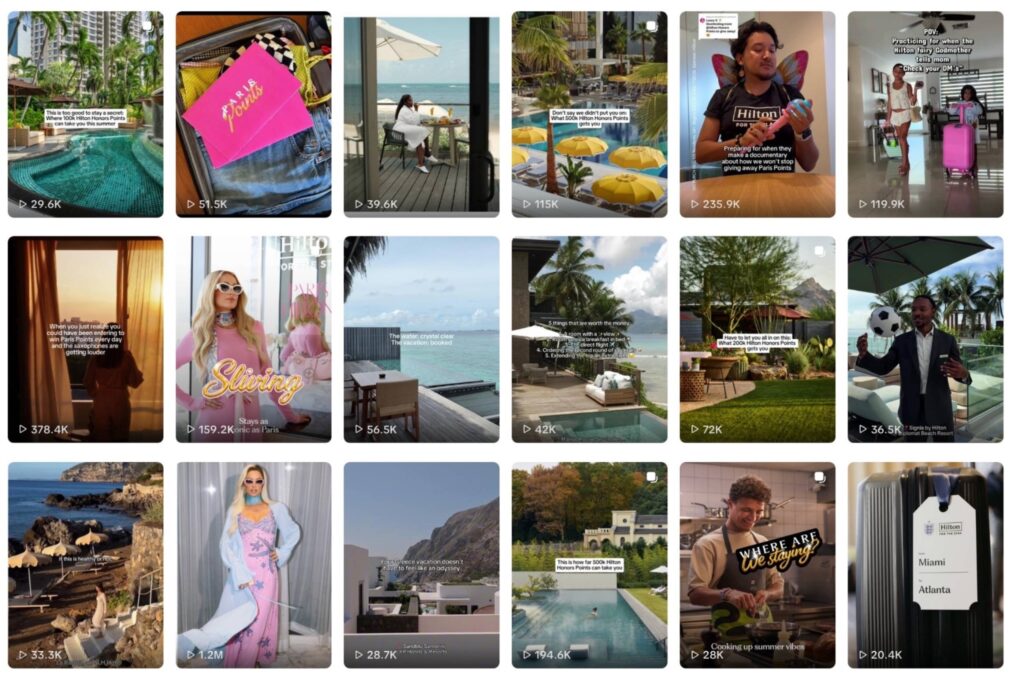
Short videos on Hilton’s Tiktok channel
For instance, instead of making a single “Hilton vs. Airbnb” video, the logic can be expanded into a content group around “situations where the accommodation impacts the trip.” A single insight can generate multiple videos: expectations upon check-in, key factors when selecting a room, experiences traveling with family, common inconveniences when renting accommodations, or moments that make guests feel it was “worth the money.” As a result, each video is not an isolated idea but a variation within the same content pillar.
What Can Resorts Learn from Hilton?
- Start from guest insights, not amenities. For a resort, “swimming pool,” “buffet,” or “ocean view room” are just raw materials. What drives the video is the underlying issue or desire. For example: “Traveling to a resort with small children while parents still want relaxation time” $\rightarrow$ only then do you showcase the kids’ club, children’s pool, babysitting services, or spa. One insight can yield multiple videos, rather than creating a standalone video for each amenity.
- Build repeatable formats instead of a new concept for every video. For instance, a resort can establish a fixed format like “Resort solves…”: solving a rainy day, solving a trip with small children, solving a weekend with no plans, or solving a 48-hour getaway. The format remains unchanged while the situation varies. This reduces brainstorming time for the content team and creates familiarity for viewers.
- Turn comments into “briefs” for future videos. This holds more value than simply “listening to customers.” After each video, the team can categorize comments into three groups: Questions → Objections → New Needs. Questions become Q&A videos; objections become testing or comparison videos; new needs become fresh content topics. This creates a loop: Video → Audience Reaction → Insight → Next Video, rather than a content calendar built entirely in advance.
- Do not equate virality with overall channel performance. A video with millions of views merely proves an idea gained attention. What is worth learning from Hilton is the ability to build a system where insights, formats, creators, and audience feedback continuously generate new videos. For resorts, a realistic goal is building 5–7 repeatable formats over several months, rather than placing all expectations on a single viral video.
Core takeaway from the Hilton case: Short-form video should not be operated as a series of isolated promo clips. It should be built as a system: Insight → Format → Video → Feedback → New Insight → Next Video. This is the framework resorts can adapt into their own production workflows.
2. Hoiana Resort & Golf: Amplifying Content Through the Right Influencers
In its campaign targeting the Singapore and Malaysia markets, Hoiana Resort & Golf collaborated with Grow Public Relations to organize multi-month stay experiences for influencers and media outlets over a 6-month period. Instead of producing content solely from a brand perspective, the campaign brought creators directly into the stay, culinary, and activity experiences at the resort, allowing them to retell the story through their own lens. According to figures published by Grow Public Relations, the campaign generated 104 influencer posts, 28 media coverage articles, over 8 million impressions, a 1,092% ROI, and earned media value exceeding 1 million SGD.
The key lesson is not simply “inviting influencers to the resort,” but knowing how to turn a single experiential trip into multiple content sources. Within the same resort, a golf creator focuses on the golf course, a culinary creator highlights the restaurants, a family creator features activities for children, while a lifestyle creator documents the entire vacation journey. For short-form video, this provides the brand with diverse narratives rather than a repetitive series of identical promotional clips.
What Can Resorts Learn from Hoiana?
- Design experiences with content potential. Not all great experiences translate well on camera. Resorts should proactively create “content-worthy moments”: signature dishes, unique activities, visually recognizable spaces, or unexpected surprise touchpoints.
- One experience, multiple narrative angles. You do not need to build a completely different itinerary for every influencer; what matters is providing enough touchpoints so each creator can find a story tailored to their specific audience.
- Evaluate creators by storytelling ability and target audience fit, not just follower count. For short-form content, video quality and lifestyle alignment with viewers are often far more critical than account size.
- Extend content lifespan post-campaign. Given usage rights, resorts can repurpose high-performing videos on Reels, websites, ad campaigns, or landing pages, while continuously tracking UGC from other guests following the activation.
- Measure conversion beyond reach. Impression counts show how many people were reached, but resorts need booking codes, UTM parameters, or dedicated landing pages to identify which influencers drive actual traffic and bookings.
Core takeaway from the Hoiana case: Influencer marketing for resorts should not be reduced to “inviting influencers and posting content.” It should be structured as a sequence: Experience → Multi-angle Content → Amplification → UGC → Content Repurposing. This transforms a time-bound influencer campaign into an ongoing short-form content asset that delivers sustained brand value.
3. Action Framework: Building a Short Video Strategy for Hotels and Resorts
Reflecting on case studies like Hilton and Hoiana, effective short video marketing strategy for hotels does not come from endlessly chasing viral ideas, but from a structured content system capable of production, testing, and scaling. For hotels and resorts, this system should start with customer insights, transition into repeatable formats, and combine brand content, creators, and UGC to establish touchpoints before driving toward business goals.
3.1. Start from Insights, Not Amenities
A common mistake in hotel content is turning a list of amenities into a list of videos: if there is a pool, shoot the pool; if there is a restaurant, shoot the restaurant; if there is a spa, shoot the spa. While this informs guests of what the resort offers, it rarely gives them a reason to stop and watch.
Instead, start with guest needs, pain points, or scenarios, then introduce amenities as natural elements of the story:
- Guests traveling with small children → “What to do in 24 hours at a resort when traveling with kids?”
- Couples seeking a weekend getaway → “48 hours for a getaway trip without any planning.”
- Golf enthusiasts → “A day combining golf and relaxation at the resort.”
- First-time visitors to a destination → “If you only have 2 days in Hoi An, how should you spend your time?”
- Guests seeking complete relaxation → “Can you spend the entire weekend at the resort without stepping outside?”
Principle: Amenities are raw ingredients; customer insights are the story.
3.2. Build Repeatable Formats
A sustainable short video marketing strategy for hotels cannot depend on brainstorming a completely new concept every week. From each insight, resorts should develop formats with a repeatable structure, then vary characters, experiences, or scenarios.
For example, the “A Day at the Resort” format can evolve into “A day at the resort with kids,” “A romantic day for couples,” “A day for golfers,” or “A rainy day at the resort.” The format remains intact, but the story changes.
- Aim to build 5–7 core formats initially.
- Each format should have the potential to generate multiple videos rather than being a one-off.
- After a testing period, retain formats showing strong signals in watch time, shares, saves, or follow-up actions.
- Not every video needs to go viral; what matters is that the format can be reused and refined across production cycles.
3.3. Design Content for Each Stage of the Booking Journey
Not every video needs to sell rooms directly. Some videos serve to capture attention, while others help guests evaluate options and make decisions.
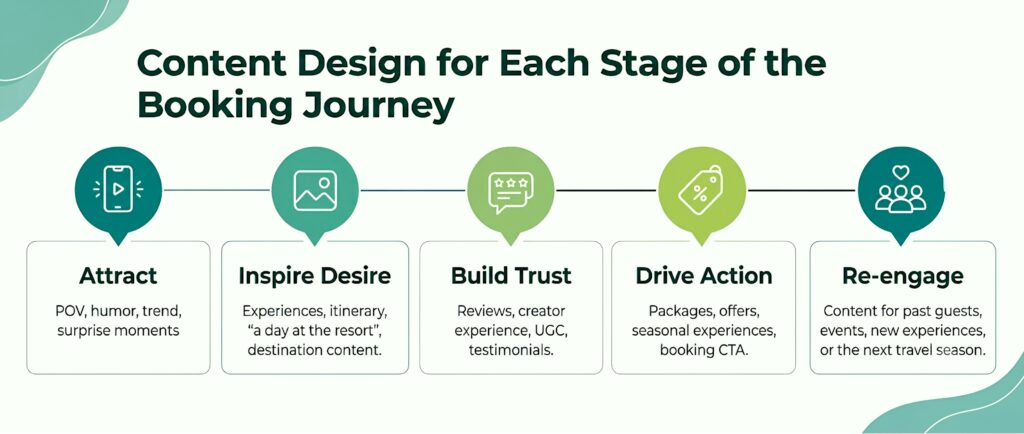
Content design for each stage of the Booking Journey
This breakdown helps resorts relieve the pressure that every single video must achieve high view counts or directly generate bookings.
3.4. Measure from Views to Business Actions
View count remains an important metric, but it is insufficient to evaluate short-form marketing effectiveness for hospitality. A video with hundreds of thousands of views might only drive top-funnel awareness, whereas a video with fewer views watched by the right target audience who then clicks through to the website holds a different level of business value.
Track metrics across distinct layers:
- Attention: Views, reach, average watch time, completion rate.
- Engagement: Comments, shares, video saves.
- Intent: Profile visits, website clicks, direct messages, room page views.
- Conversion: Bookings, inquiries, promo code redemptions, conversions via UTM links or custom landing pages.
Crucially, this data must feed back into the content production workflow. If a “48 Hours at the Resort” video yields more saves and clicks than a standard room tour, that serves as a signal to further expand itinerary-based formats rather than relying solely on vanity metrics like likes.
Asia Golf Journey – Your Leading Strategic Marketing Partner
If you are seeking an experienced partner in hospitality and resort marketing to build a structured short video marketing strategy for hotels from brand positioning and content production to conversion tracking, Asia Golf Journey is ready to accompany your hotel or resort.
Contact Us for Consultation:
📞 +84 982 117 466
📧 creative@asiagolfjourney.com
Leading Strategic Partner In Golf, Sports & Tourism – Hospitality In Vietnam