The country is tracking well ahead of most competing destinations but the market composition is shifting, and the implications for golf and hospitality operators are significant.
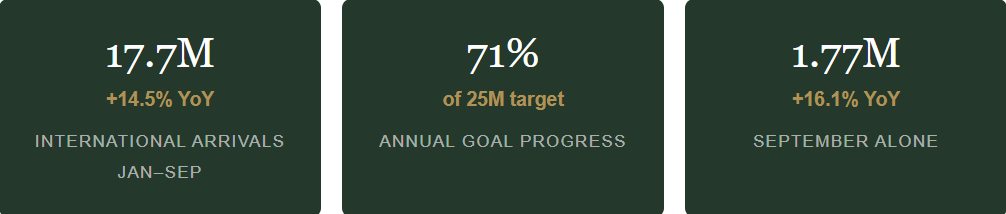
Vietnam’s tourism authority has released its nine-month performance figures for 2026, and the headline number is strong: 17.7 million international visitors arrived between January and September, representing a 14.5% increase over the same period in 2025. At that pace, Vietnam has reached 71% of its annual target of 25 million international arrivals with a full quarter still remaining.
The country is tracking well ahead of most competing destinations but the market composition is shifting, and the implications for golf and hospitality operators are significant.
To put the growth in context: the United Nations World Tourism Organization reported global international arrivals grew just 0.4% in the first half of 2026. Vietnam is outpacing the global average by a factor of more than thirty. The momentum has also been building: September alone recorded 1.77 million arrivals, up 16.1% from September 2025.
Who Is Actually Coming
The aggregate growth number masks some notable shifts at the market level. China and South Korea together still account for nearly 40% of all arrivals — 3.9 million and 3.0 million respectively — but their trajectories are diverging sharply.
The aggregate growth number masks some notable shifts at the market level. China and South Korea together still account for nearly 40% of all arrivals — 3.9 million and 3.0 million respectively — but their trajectories are diverging sharply.
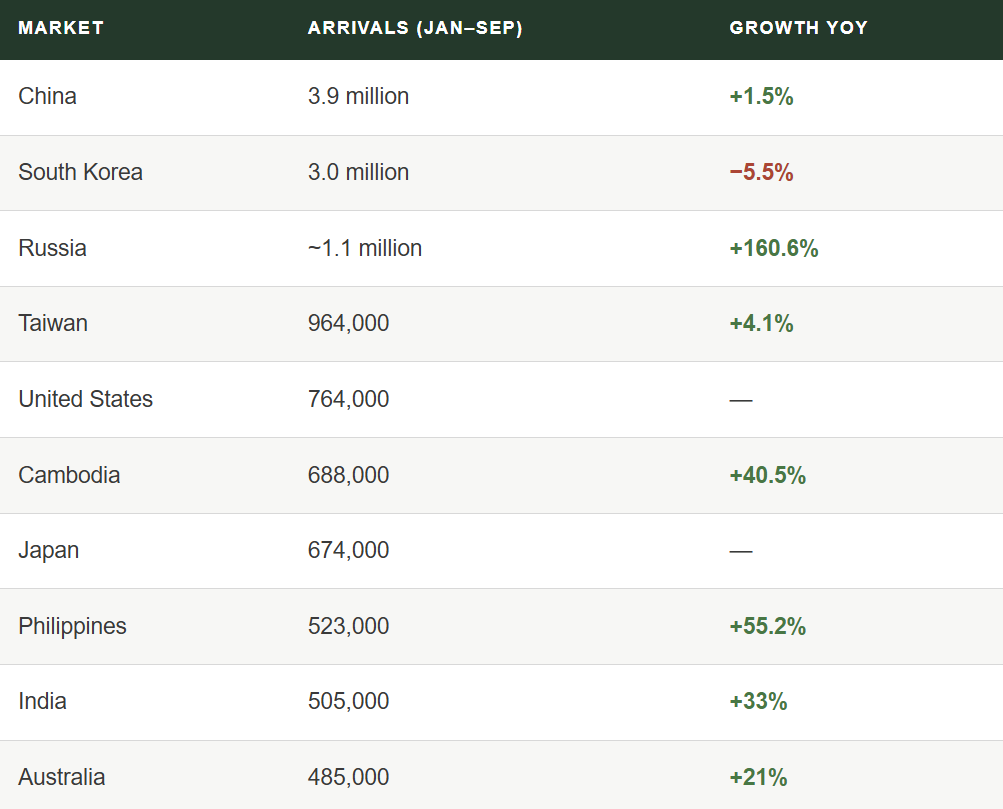
Russia’s growth is the most striking: 1.1 million arrivals, up 160.6% year-on-year, making it the largest European source market for Vietnam. Europe as a whole grew 55%, while traditional Asian feeder markets expanded more modestly at 7.6%, still a large base, but clearly slower momentum than the markets further afield.
“Europe grew 55% year-on-year. Russia passed one million arrivals for the first time. These are not incremental shifts, they represent a structural change in who is choosing Vietnam.”
Other fast-growing markets include the Philippines (+55.2%), India (+33%), Cambodia (+40.5%), and Poland (+49%). Air travel continues to dominate at 83.2% of arrivals, but land arrivals grew 29.9% a reflection of increasing cross-border movement from Cambodia, Laos, and China.
The Korean Market: A Useful Warning Sign
South Korea deserves a separate read. At 3.0 million visitors, Korean travelers remain Vietnam’s second-largest source market by volume and among the most important for golf tourism, given Korea’s high golf participation rate and the well-established pattern of Korean golf groups traveling to Da Nang, Phan Thiet, and Hanoi’s outlying golf corridors.
A 5.5% decline in that market is not a crisis, but it is a signal worth watching. Whether the dip reflects general outbound travel patterns from Korea, price sensitivity, or a shift toward competing destinations like Thailand or Japan is not yet clear from the aggregate data. For golf and hospitality operators with a heavy reliance on the Korean group market, the question is worth asking now rather than at year-end.
According to UN Tourism, global international arrivals grew just 0.4% in the first half of 2026, with a revised full-year forecast of 1–2%. Vietnam’s 14.5% growth over the same period is one of the strongest performances among major tourism markets in Southeast Asia.
Global Context
What the Growth Means for Golf and Hospitality
The underlying trajectory is positive for Vietnam’s golf and resort sector, but the market mix shift is the more important story for operators. Courses and resorts that built their commercial model around Korean and Chinese group bookings, the dominant pattern for much of the past decade are looking at a market where those segments are either stagnant or declining, while new source markets (Russian, Indian, European, and ASEAN travelers) are growing fast but may require different product offerings, communication approaches, and booking channels.
Russian golfers, for example, tend to travel in smaller groups, favor premium experiences, and book through different tour operator networks than Korean group travelers. Indian golfers are a growing but still-developing segment more likely to be staying at a resort for leisure and adding a round or two, rather than arriving as a dedicated golf group. European and Australian visitors tend to have higher average spend and longer stays, but the golf participation rate within those traveler pools varies considerably.
The simplest read of the data for the golf sector: Vietnam’s inbound tourism base is growing and diversifying. Resorts and courses that adapt their marketing and distribution now, before the mix fully shifts, are better positioned than those waiting for volumes to normalize around the old model.
The 14.5% growth headline is worth celebrating. But the number that should get more attention from golf and hospitality operators is the Korean decline. Korea has been the structural pillar of golf tourism to Vietnam for years, the golf-specific traveler, the repeat visitor, the group that books eight tee times on a single morning. A 5.5% dip in that segment, even if partially seasonal or temporary, is a prompt to audit channel dependency.
The rise of Russia, India, and broader Europe as meaningful source markets is a real opportunity but reaching those travelers requires a different approach to distribution, partnerships, and communication. Most Vietnamese golf and resort operators are not yet set up for it. The gap between where the new volume is coming from and where the marketing infrastructure currently points is where the strategic work needs to happen over the next twelve months.
Sources: Vietnam National Authority of Tourism (via baoquocte.vn, October 2026); VietnamPlus (en.vietnamplus.vn, October 2026); UN World Tourism Organization. © 2026 Asia Golf Journey.